
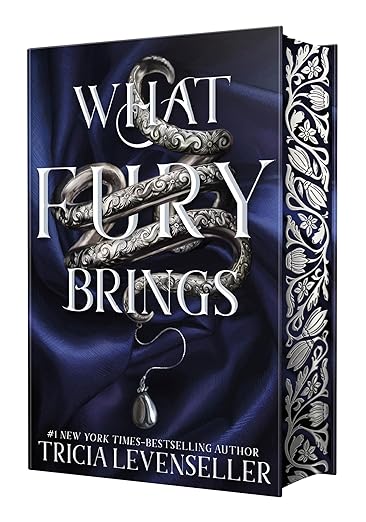
I’ll be honest, I struggled a little with this one. Not because Tricia can’t write (her books always grab my attention), but because of the sheer amount of rage packed into this story. This world is steeped in hate and feminine fury, which at times felt heavy, but also…real. If women were ever forced back into systemic servitude, I could see a society spiraling like this. Hate breeds hate. And when pain goes unhealed, it spills onto people who had nothing to do with your scars.
The setup (quick, spoiler-light)
After a failed rebellion in Amarra, most noblemen are dead and the matriarchy survives by kidnapping husbands from neighboring kingdoms. Olerra—warrior princess, throne contender—targets the “perfect” husband to solidify her claim: Sanos, the sweet-tempered second-born prince from an enemy land. Except…he’s not who she thinks he is, and neither of them is ready for what their collision exposes.
What worked for me
- The moral ambiguity. “Who’s the real villain?” genuinely depends on your bias. That’s deliberate, and it’s the most interesting part of the book.
- Timeliness. We’re watching, in real time, how women are being made small again—bodies legislated, choices narrowed. This story feels like a warning about swinging too far in any direction.
- Character friction. Olerra’s ruthlessness vs. Sanos’s conditioning makes for sharp, uncomfortable conversations about power, entitlement, and what people justify in the name of safety.
Where I struggled
- The heaviness. I expected something sharper-and-fun, but it leans darker and more contemplative. Not a flaw—just a mismatch with my mood.
- The hate cycle. The book lives in anger (intentionally), and that can feel repetitive if you’re hoping for more reprieve or levity along the way.
Devil’s advocate corner (let’s poke the bear)
- “Reverse oppression” narratives can be tricky. A matriarchy that kidnaps men risks flattening nuance into “see, women would be just as bad.” If that reading turns you off, I get it.
- Counterpoint: As a thought experiment, it works. The point isn’t “women bad/men bad,” it’s “power without accountability corrupts.” The book asks: if you’ve been brutalized by a system, do you dismantle it—or remake it in your image? (And does that difference matter to the people under your boot?)
- Consent and coercion. The central premise uses kidnapping to interrogate agency. If that trope is a hard no for you, absolutely valid. If you can sit with the discomfort, the story opens up space to examine how easily noble intentions slide into control.
Bigger themes I kept circling
- Violence as language: When oppression is the only dialect you’ve heard, it’s the one you speak back.
- Inheritance of harm: None of us is neutral. We inherit beliefs, fears, and scripts; unexamined, they run us.
- Balance vs. victory: Equality isn’t about “winning” for one gender; it’s about refusing the game that requires someone to lose.
Favorite dynamic
Watching Olerra and Sanos unlearn (or cling to) what their worlds taught them—about strength, softness, leadership, obedience—was the heart of the book. Their scenes aren’t cozy; they’re interrogations dressed as banter, and I liked the sting.
Content notes (so you’re not blindsided)
Kidnapping/forced proximity, gendered power imbalances, systemic oppression, violence (on- and off-page), threats of coercion. Tone skews dark.
A line that sums up my read
“If you don’t heal what hurt you, you’ll bleed on those who never cut you.”
Final thoughts & rating
Dark, sharp, and more thought-provoking than “fun,” this wasn’t the quick, playful escape I expected—but it lingered. And that’s something I’ll always appreciate in Tricia Levenseller’s writing.
Rating: 4/5
Talk to me (comments welcome!)
- Do “role-reversal” power structures help you think about real-world systems—or do they feel like false equivalencies?
- Where’s your line with consent in fantasy settings: hard stop at kidnapping tropes, or case-by-case if the book interrogates it?
- If you read this, who did you think the real villain was—and did that change by the end?
 Vikki's Book Nook
Leave a comment